
Homelab
3-host vSAN ESA cluster on ESXi 9.1, one site, vCenter 9.1. Built it around 2024. Runs 24/7, runs the house, and teaches the day job.
Unsupported, by design
None of this is a supported configuration. The hosts, drives and network were picked for a homelab budget and a shelf in my house, and some of it sits below what features ask for: the 9.0 global dedup announcement called for 25GbE, and this fabric is 10G. I run it to learn how the stack behaves and to test what I write about.
When a write-up says I enabled something in the lab, it means it ran here. It doesn't mean the setup is supported, certified or recommended, and nothing on this site is Broadcom guidance. If you're designing something for production, start from the Broadcom Compatibility Guide and the official VMware Cloud Foundation documentation.
The setup
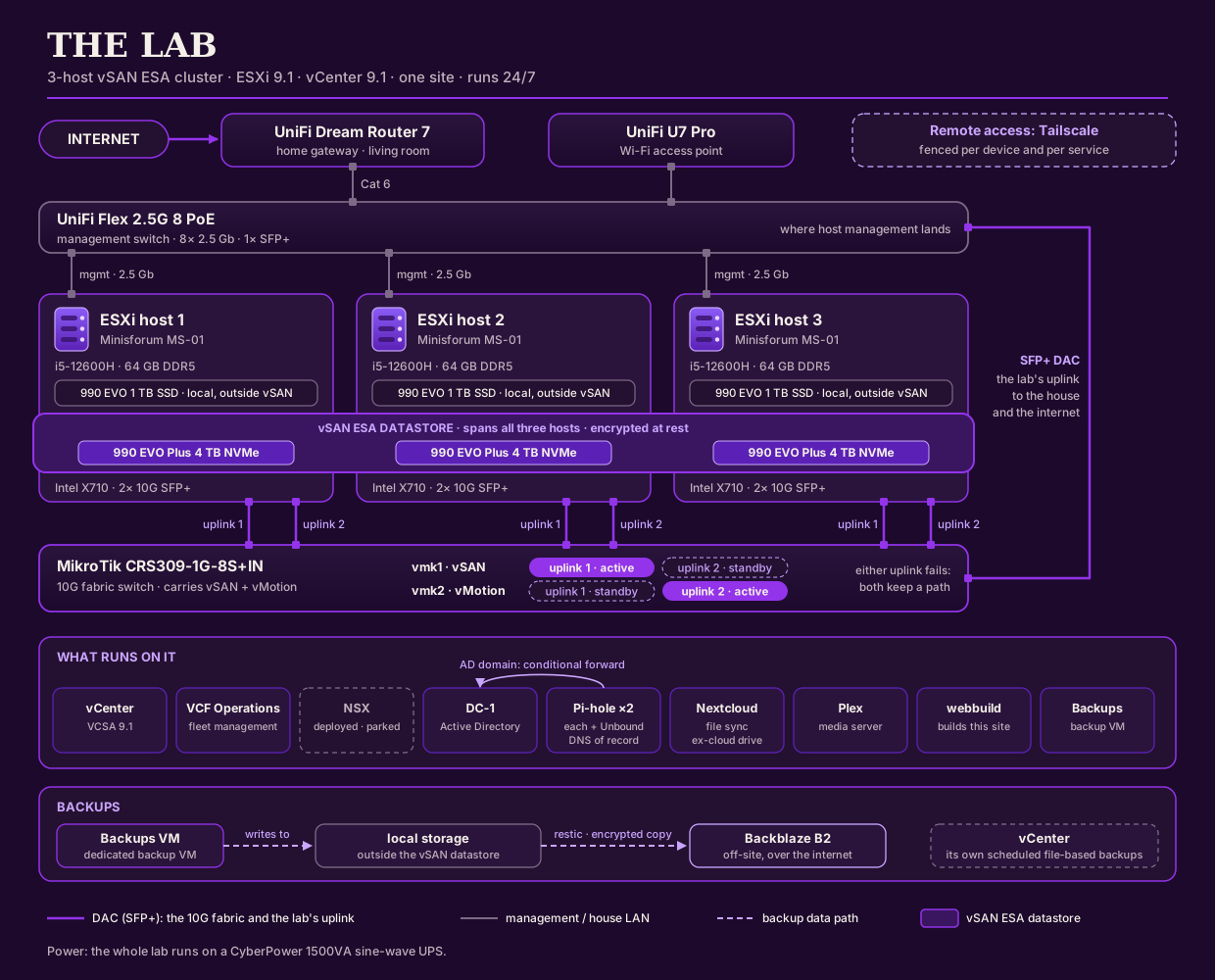
Hosts are three identical Minisforum MS-01s. Each has an i5-12600H, 64GB DDR5, and an Intel X710 with two 10G SFP+ ports. vSAN ESA is a Samsung 990 EVO Plus 4TB NVMe in each. A Samsung 990 EVO 1TB SSD in each is local storage outside the vSAN datastore. Cluster encrypts vSAN at rest.
Fabric switch is a MikroTik CRS309-1G-8S+IN. Hosts connect to it with DAC cables. That switch carries vSAN and vMotion.
Management is separate. UniFi Flex 2.5G 8 PoE switch with eight 2.5Gb ports and one SFP+ is where host management lands. Its SFP+ connects into the CRS309 with a DAC, and that link is how the lab reaches the house and the internet. Cat 6 from the same switch runs to a UniFi Dream Router 7 in the living room. UniFi U7 Pro hangs off the management switch too.
The whole lab runs on a CyberPower 1500VA sine-wave UPS.
Not on the UPS: Smaug, a Fire Dragon maple. Status page.
The diagram
The fabric
Each host has two 10G uplinks into the CRS309. vSAN rides vmk1, active on uplink 1 and standby on uplink 2. vMotion rides vmk2, the mirror: active on uplink 2 and standby on uplink 1. If either uplink fails, both services still have a path. The DAC from the UniFi switch into the CRS309 is the lab's uplink. Remote access is Tailscale, fenced per device and per service.
What runs on it
vCenter is one VCSA 9.1. VMs: DC-1 runs Active Directory. Nextcloud is the file sync that replaced my old cloud drive. Two Pi-hole instances, each with Unbound, are the DNS of record. Plex is the media server. VCF Operations is fleet management. Backups run on their own VM. webbuild is the build box this site is made on.
Pi-holes conditionally forward the AD domain to the domain controller so DNS and the directory stay coherent. The long version is the launch article.
NSX is deployed and currently parked.
Backups
Backups: a dedicated backup VM writes to local storage. restic ships an encrypted copy off-site to Backblaze B2. vCenter keeps its own scheduled file-based backups. First full restore test passed. First fully unattended weekend passed 4/4 in October 2026.